

Introduction
Safety is the paramount of Civil Aviation. That’s totally normal, given the number of casualties that could result from a single air crash.
This is why ICAO, through its standards and recommended practices, adopted a set of rules and regulations that must be followed by all the Contracting States in order to ensure and improve aviation safety.
However, despite all of that, accidents (air crashes) may happen…and they do. This is why investigations are carried out in order to determine the causes, the contributing factors if possible, and to propose safety recommendations. The objective is to make sure similar occurrences will not happen again.
In this article, we will go through how air crash investigations are conducted. Fasten your seatbelts, we are ready for takeoff (no worries, we will not crash) !
Terminology
Before going any further, let us lay the ground work by defining some key terms. These definitions are the ones provided by ICAO in its Annex 13 related to accident investigation.
Accident
An occurrence associated with the operation of an aircraft which, in the case of a manned aircraft, takes place between the time any person boards the aircraft with the intention of flight until all such persons have disembarked; or, for an unmanned aircraft, between the time it is ready to move for flight until it comes to rest and the primary propulsion system is shut down, in which:
a) A person is fatally or seriously injured due to:
- being in the aircraft,
- direct contact with any part of the aircraft (including detached parts),
- or direct exposure to jet blast;
except for injuries from natural causes, self-inflicted injuries, or those inflicted by others, or to stowaways hiding in areas not normally accessible to passengers and crew.
b) The aircraft sustains damage or structural failure that:
- adversely affects its structural strength, performance, or flight characteristics, and
- would normally require major repair or replacement of the affected component;
excluding engine failure/damage limited to a single engine, or minor damage to propellers, wing tips, landing gear, etc.
c) The aircraft is missing or completely inaccessible.
Incident
An occurrence, other than an accident, associated with the operation of an aircraft which affects or could affect the safety of operation.
Serious incident
An incident involving circumstances indicating that there was a high probability of an accident, associated with the operation of an aircraft, occurring between the time any person boards the aircraft with the intention of flight until all such persons have disembarked (or equivalent phases for unmanned aircraft).
Causes
Actions, omissions, events, conditions, or a combination thereof, which led to the accident or incident. The identification of causes does not imply the assignment of fault or the determination of administrative, civil, or criminal liability.
Contributing factors
Actions, omissions, events, conditions, or a combination thereof, which, if eliminated, avoided, or absent, would have reduced the probability of the accident or incident occurring, or mitigated the severity of its consequences.
The identification of contributing factors does not imply the assignment of fault or the determination of administrative, civil, or criminal liability.
Safety recommendations
A proposal of an accident investigation authority based on information derived from an investigation, made with the intention of preventing accidents or incidents.
It shall not be used to assign blame or liability. Safety recommendations may also arise from other sources such as safety studies.
Which State carries out investigation?
The State in the territory of which the accident/incident occured shall carry out the Investigation. If it does not want to or if it does not have the means to do so, then the responsibility falls respectively to the State of Registry, the State of the Operator, the State of Design and the State of Manufacture.
The graph below sums up in a clear way what the different possibilities are as far as accident investigation duty is concerned.
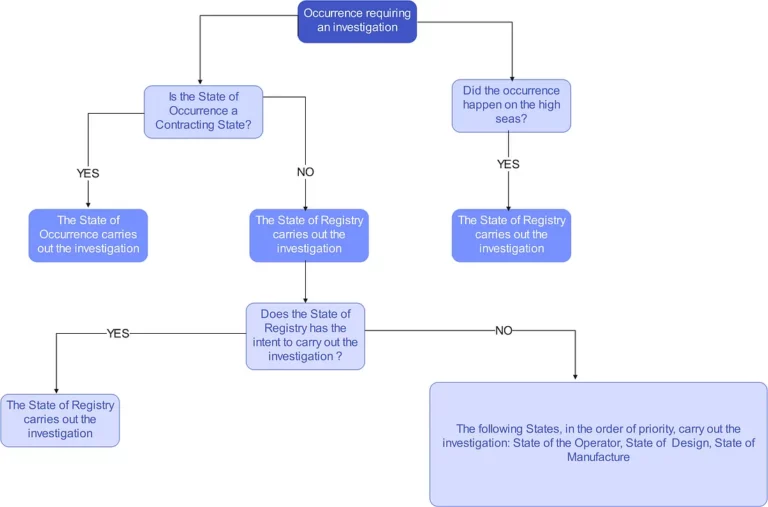
The Air Crash investigation steps
Notification
The first thing that the State of occurrence does is to notify the other States. This must be done “with a minimum of delay” and by the “most suitable and quickest means available” . This task is the responsibility of the the local Accident investigation authority.
Team constitution
Now that all the States, are notified, time to procede with the team building. In addition to the investigating State, other involved States can appoint accredited representatives to participate in the process and ensure their interests are considered
Note: States whose nationals are victims can also participate in the investigation if they wish.
Accident Investigation
Once the states are notified and the teams are constituted, time to proceed with the accident investigation. As stated earlier, the ultimate goal is to figure out the causes and the contributing factors in order to provide safety recommendations that would help improve aviation safety.
Detailed investigation techniques will be tackled in another article. For now, let’s just know that one of the main part of the investigation is the analysis of flight recorders. This is mandatory in order to get an overview of how the flight went on.
Accident investigation report
Thirty days after the start of an accident investigation, a preliminary report shall be published. The goal is to “disseminate the data obtained during the early stages of the investigation”.
After the investigation is over, a report shall be produced and made public. In it, all the information related to the flight, the causes, contributing factors as well as safety recommendations shall be detailed.
In some cases, the accident investigation may take some time. Hence, a public declaration shall be made every year after the date of the occurrence, until the investigation is over and the final report is published. The declaration’s intent is to provide the public with informations on how the Investigation is going and the potential safety concerns.
Conclusion
Air crash investigations play a crucial role in improving aviation safety by identifying causes and preventing future incidents. Through a thorough and transparent process, these investigations ensure that air travel remains as safe as possible for all.